Abel, N. H. Oeuvres Completes, Vol. 2 (Ed. L. Sylow and S. Lie). New York: Johnson Reprint Corp., pp. 189-192, 1988.Bytsko, A. G. "Fermionic Representations for Characters of , , and Minimal Models and Related Dilogarithm and Rogers-Ramanujan-Type Identities." J. Phys. A: Math. Gen.32, 8045-8058, 1999.Bytsko, A. G. "Two-Term Dilogarithm Identities Related to Conformal Field Theory." 9 Nov 1999. http://arxiv.org/abs/math-ph/9911012.Campbell, J. M. "Some Nontrivial Two-Term Dilogarithm Identities." Irish Math. Soc. Bull., No. 88, 31-37, 2021.Euler, L. Institutiones calculi integralis, Vol. 1. Basel, Switzerland: Birkhäuser, pp. 110-113, 1768.Gordon, B. and McIntosh, R. J. "Algebraic Dilogarithm Identities." Ramanujan J.1, 431-448, 1997.Khoi, V. T. "Seifert Volumes and Dilogarithm Identities." J. Knot Th. Ram.23, 1450025, 11, 2014.Lewin, L. "The Dilogarithm in Algebraic Fields." J. Austral. Math. Soc. (Ser. A)33, 302-330, 1982.Lewin, L. (Ed.). Structural Properties of Polylogarithms. Providence, RI: Amer. Math. Soc., 1991.Loxton, J. H. "Partition Identities and the Dilogarithm." Ch. 13 in Structural Properties of Polylogarithms (Ed. L. Lewin). Providence, RI: Amer. Math. Soc., pp. 287-299, 1991.Rogers, L. J. "On Function Sum Theorems Connected with the Series ." Proc. London Math. Soc.4, 169-189, 1907.Watson, G. N. "A Note on Spence's Logarithmic Transcendent." Quart. J. Math. Oxford Ser.8, 39-42, 1937.


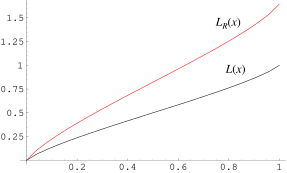
 表示通常的 双对数函数,那么有两种变体被稍微不同的归一化,都称为罗杰斯
  -函数(Rogers 1907)。Bytsko (1999) 定义

![6/(pi^2)[Li_2(x)+1/2lnxln(1-x)]](/images/equations/RogersL-Function/Inline5.svg)


![6/(pi^2)[sum_(n=1)^(infty)(x^n)/(n^2)+1/2lnxln(1-x)],](/images/equations/RogersL-Function/Inline8.svg)
 -函数定义为




![[sum_(n=1)^(infty)(x^n)/(n^2)+1/2lnxln(1-x)].](/images/equations/RogersL-Function/Inline18.svg)
 满足简洁的 反射关系

 从 阿贝尔函数方程 得出,并由下式给出
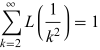
 表示,众所周知的双对数函数恒等式变为


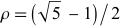 。
。
 是 黄金比例 (Khoi 2014, Campbell 2021)。
 满足
满足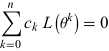
 值,被称为 L-代数数。Loxton (1991,p. 289) 给出了一系列具有有理系数的恒等式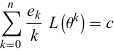
 是一个 有理数,其修正和扩展版本总结在下表中。在该表中,多项式
  表示
表示  的实根。可以使用 整数关系 算法找到更多类似的恒等式。



























 ,
,
























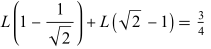
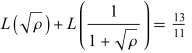




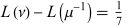


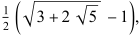
 是
是
 和
和  是
是
 (Gordon 和 McIntosh 1997, Bytsko 1999)。
 变量中的双对数函数恒等式,其中有
  项,当
项,当  时简化为欧拉恒等式,当
  时简化为 阿贝尔函数方程 (Gordon 和 McIntosh 1997)。对于
  ,它等价于
,它等价于







 ,
,  ,
,  and
and  Minimal Models and Related Dilogarithm and Rogers-Ramanujan-Type Identities." J. Phys. A: Math. Gen. 32, 8045-8058, 1999.Bytsko, A. G. "Two-Term Dilogarithm Identities Related to Conformal Field Theory." 9 Nov 1999.
  ." Proc. London Math. Soc. 4, 169-189, 1907.Watson, G. N. "A Note on Spence's Logarithmic Transcendent." Quart. J. Math. Oxford Ser. 8, 39-42, 1937.